Built By Few Milan: With Europe’s Top Product Builders

Built By Few Milan: With Europe’s Top Product Builders

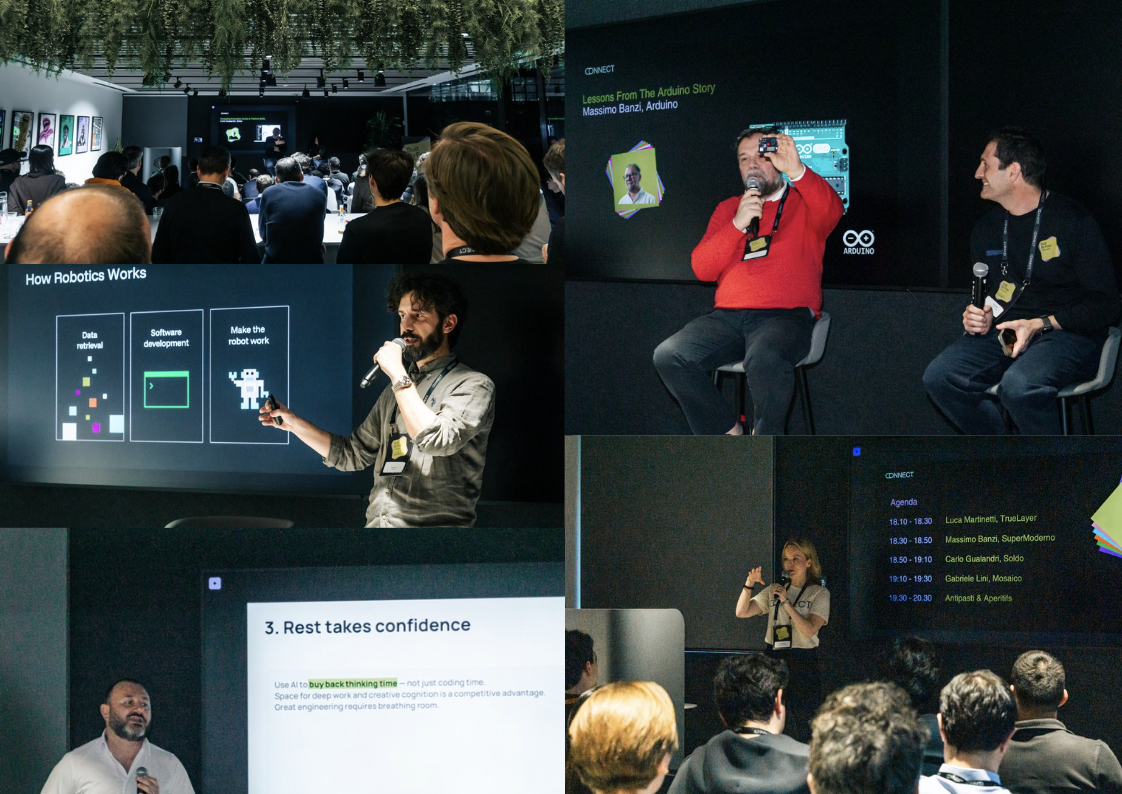
We brought Built By Few to Milan for the very first time - and what a way to land in Italy. With over 100 founders, operators, and investors in the room, we gathered some of Italy’s sharpest product minds.
The energy? Electric. The conversations? Unfiltered. The insights? Invaluable. And, in true Milanese fashion, we wrapped it all up with an aperitivo 🫒🍷.
We were incredibly lucky to host four standout builders:
Luca Martinetti (TrueLayer) on scaling fintech infrastructure, growth, and applying AI in fast-moving environments
Massimo Banzi (Arduino / SuperModerno) on building one of the world’s largest open-source communities
Carlo Gualandri (Soldo) on the discipline required to build products users truly love
Gabriele Lini (Mosaico) on unlocking the future of robotics through better data systems
Each brought a different lens but together, they painted a clear picture of what it takes to build enduring products from Europe:
1. Alignment Is the Real Bottleneck
One theme came up again and again: great companies are built by aligned teams. Not faster code and better tools, but alignment. In a world where AI is rapidly lowering the barrier to execution, the differentiator is no longer speed - it’s clarity of mission and the ability to move in the same direction. Teams that obsess over alignment build companies that last.
2. AI Amplifies - It Doesn’t Replace
There was a refreshingly grounded take on AI across the board. AI is powerful, but it’s not magic. It amplifies existing processes, it rewards strong operators, and it exposes weak thinking. The best teams aren’t chasing every new model - they’re focused on applying the best tools available today to real problems. And, importantly, reflection, rest, and clear thinking still matter more than constant AI-assisted output.
3. Community Is a Growth Engine
Arduino’s journey is a masterclass in community-led growth. What started as a simple tool for design students became a global movement. This was not through paid acquisition, but through hand-built communities, workshops across Europe, and showcasing user projects as the main form of marketing
The takeaway was clear that communities don’t magically appear, but instead that they’re built through effort, consistency, and doing things that don’t scale.
4. Great Products Take Relentless Work
It was clear from our speakers that there’s no shortcut here and that building something users genuinely love requires a deep care for the product experience, an obsession over details, and, of course, a “get it done” mentality.
As Carlo put it: “businesses only work when all parts are strong: business, product, and technology”. Neglect one, and the whole system breaks.
5. User experience Is a Competitive Advantage
One of the most powerful ideas from Built By Few Milan was that innovation often comes from superior and innovative UX.
Massimo told us that: “Arduino was not primarily a technological breakthrough, but innovation in the user experience.” Arduino succeeded not by making technology more complex but by making it accessible. By lowering barriers, removing friction, and enabling early wins for users, it created momentum that compounded over time.
6. The Next Wave: Physical AI
Gabriele Lini highlighted a massive opportunity in robotics and physical AI: “Today, more than half of robotics development time is spent not on building, but on managing data pipelines”. He dug into why the next frontier isn’t just better models, it’s better infrastructure through unified data systems, standardised workflows and developer-friendly tools. Whoever solves this unlocks an entirely new wave of innovation.
7. The “Seven-Year Overnight Success”
And, there was a key final reminder that resonated across every story that, what looks like overnight success, is usually years in the making. In the early days, most founders faced skepticism and sometimes outright dismissal. But that phase is often an advantage, as it gives builders the space to experiment, iterate, and quietly get better while no one is watching. What events like this prove is that when you bring them together, the learning compounds fast.
So, what’s next?
Milan was just the beginning. We’re taking Built By Few on the road - and gearing up for our flagship summit later this year. If you want to be part of the next one, stay tuned and register your interest here.
Avanti tutta 🚀.